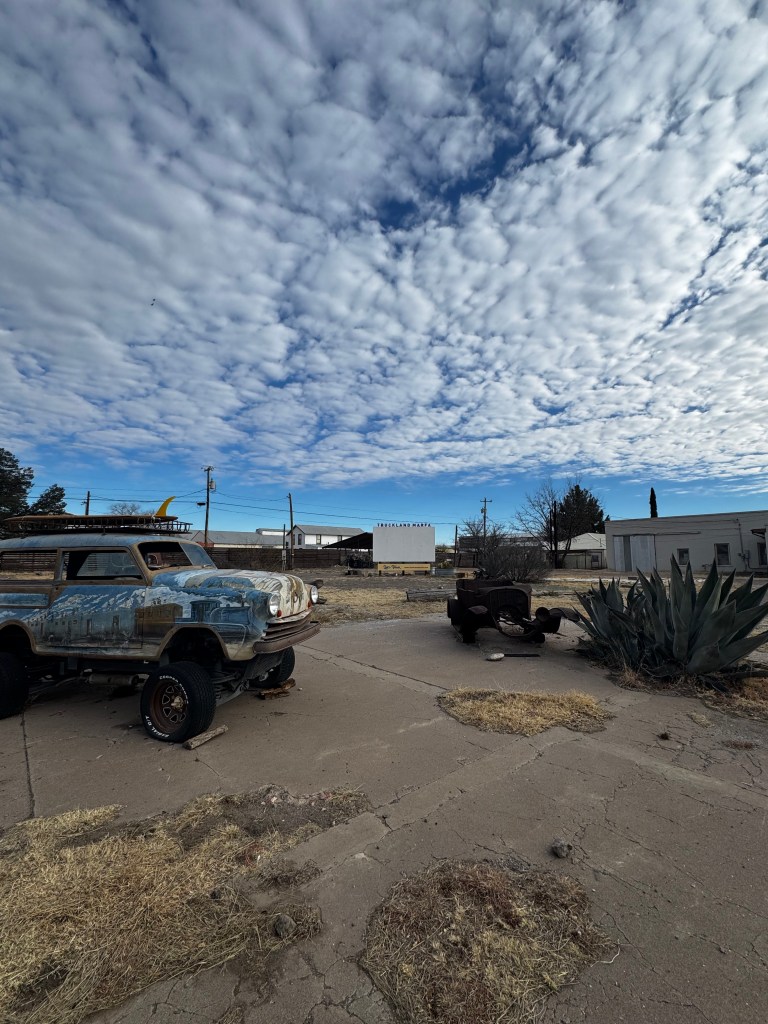
We rolled into Marfa last night, after the longest leg of our trip so far—about 511 miles—from the Coronet Cafe in Tucson where we had a lovely parting lunch with Tali all the way to Marfa, with a stop at a medicore Texas steakhouse on the outskirts of El Paso the dining room was decked out with fake, lit-up trees.
It was dark by the time we rolled into West Texas and we drove past the famous Prada store installation, doing a U-turn to check it out. It was freezing and empty, the storefront lit up like a ghost. The installation was amusing, but much less so than the inky canopy of sky, festooned with stars. West Texas is one of the least light-polluted places on Earth, and it felt that way, disorienting in its emptiness. I was a little rattled after rolling through a Customs and Border Patrol checkpoint and passing several trucks of armed federal officers on the lookout for anyone they didn’t think belonged on this side of the Mexican border. It’s difficult to grasp that there is so much space and so little compassion.
I have always been curious about Marfa, although what I knew about the place was quite vague. It was an art town in the middle of nowhere, put on the map by an artist I knew very little about: Donald Judd. When Pele came here last year during his school’s Southwest Studies trip, he said it was cool, although he didn’t elaborate , and Margi also encouraged us to make it a stop on our journey.
I am so glad we’re here. For a variety of reasons, it feels like kismet. (And that’s not just the two artisanal sotol cocktails talking.) We went on two separate tours today: one of Judd’s residence, La Mansana de Chinati, also known as The Block, and later, in the afternoon, of several of his studios. We ended up having a bunch of excellent conversations with our guides and the other guests, some of whom I initially viewed with wariness or suspicion. I found myself repeatedly marveling at the way Judd studiously created a life for himself according to his principles and beliefs and, as we walked around this town of fewer than 1,200 residents with a ridiculously high concentration of hip, stylish stores, cafes, galleries, and restaurants, I felt excited about moving to another town that is being re-enlivened by the arts.
After the second tour of the day, we popped into the Marfa Public Library to pee. The place was a little slice of heaven, with little kids filling out worksheets that prompted them to write down a food for every letter in the alphabet, the young librarians offering them fruit roll-ups, and two women catching up on the latest in their lives. Around back, there was a barn with books for sale for between one and two dollars and, even though our car is literally bursting at the seams, we couldn’t help but pick up $20 worth of poetry and mysteries and novels. (I am still in awe of Judd’s library which, in addition to containing thousands of books on a galaxy’s worth of topics, housed a few elegant plywood beds where he could curl up with a book whenever the mood struck him.)
The night ended with Owen and I sitting in a barrel sauna and, once again, geeking out on the night sky, unknowable and unfathomable.
During our Judd Foundation tours, we befriended a couple from Forth Worth, an architect and a family counselor who is now training to be a death doula. The architect was exasperated with Judd’s obsession with stripping many of the buildings he acquired down to their original adobe skeleton. The material, he lamented, was woefully unstable, a fact borne out by the fact that a large part of the wall surrounding his La Mansana property had collapsed after a powerful windstorm the year before. Adobe, he continued, was impractical, requiring constant upkeep.
Later, as we were climbing up the stairs to the exquisite, light-filled apartment Judd created above his architecture office shortly before he died, the death doula talked about how traditionally families would come together to fortify and repair their adobe homes every few years, a ritual that reminded me of a village in Japan that we visited where the straw houses were remade collectively by its residents every year. (She also told me about a lady from Tennessee who is brought in to identify the composition of bricks in historical buildings, which she did by licking them. I would LOVE to meet and interview this woman.)
For obvious reasons, I have been thinking a lot about impermanence, and now I am thinking about adobe. Like so many of us, the Fort Worth architect is concerned with making things last as long as possible. But, as we all know deep down, that’s the very definition of hubris.
Judd, meanwhile, was fixated on stripping his surroundings down to their bones, eliminating modern comforts like electrical lights and HVAC systems from the buildings he acquired. He wasn’t interested in shielding himself from the elements, from the storms and the heat and the cold. I’m sure it wasn’t easy for his children growing up in those spaces, but I also think it must have been a gift to become comfortable with discomfort.
Metaphorically, we are all living in adobe houses, whether we like it or not.
 Hagar Writes